DC’s Continental Urban Notes

K Street NW toward New York Avenue, from Ciel, a rooftop restaurant.

Engage with this post on Substack.

I’ve spent some time in D.C. this year — mainly for work. I’m not quite an Acela commuter. It’s usually the more proletarian Northeast Regional. Which is fine. On the corridor, it only takes a few minutes longer between cities. You realize how compact we are in the Northeast.

Washington is the great city on the Eastern Seaboard that I’ve had the least time to explore. New York is home; Boston was, sort of, for about a year in my 20s; and Philly has been home to enough friends from Rutgers and elsewhere to almost feel like a place I’ve lived. But D.C. has remained a bit of a mystery. My visits over the years have tended to be packed with sights to see, and things to do; but it is in ordinary time that one really gets to know a place. Still, with several work meetings and a couple of evenings around hotel nights, I’ve begun to tentatively observe a few things about its urban personality.

From a spatial perspective, DC’s proportions feel more like those of a European capital than a typical American city in 2025. Undoubtedly, this is due in part to L’Enfant’s many wide avenues, running off at all angles from the Capitol and the Mall; and the squares and triangles with monuments where those avenues intersect.
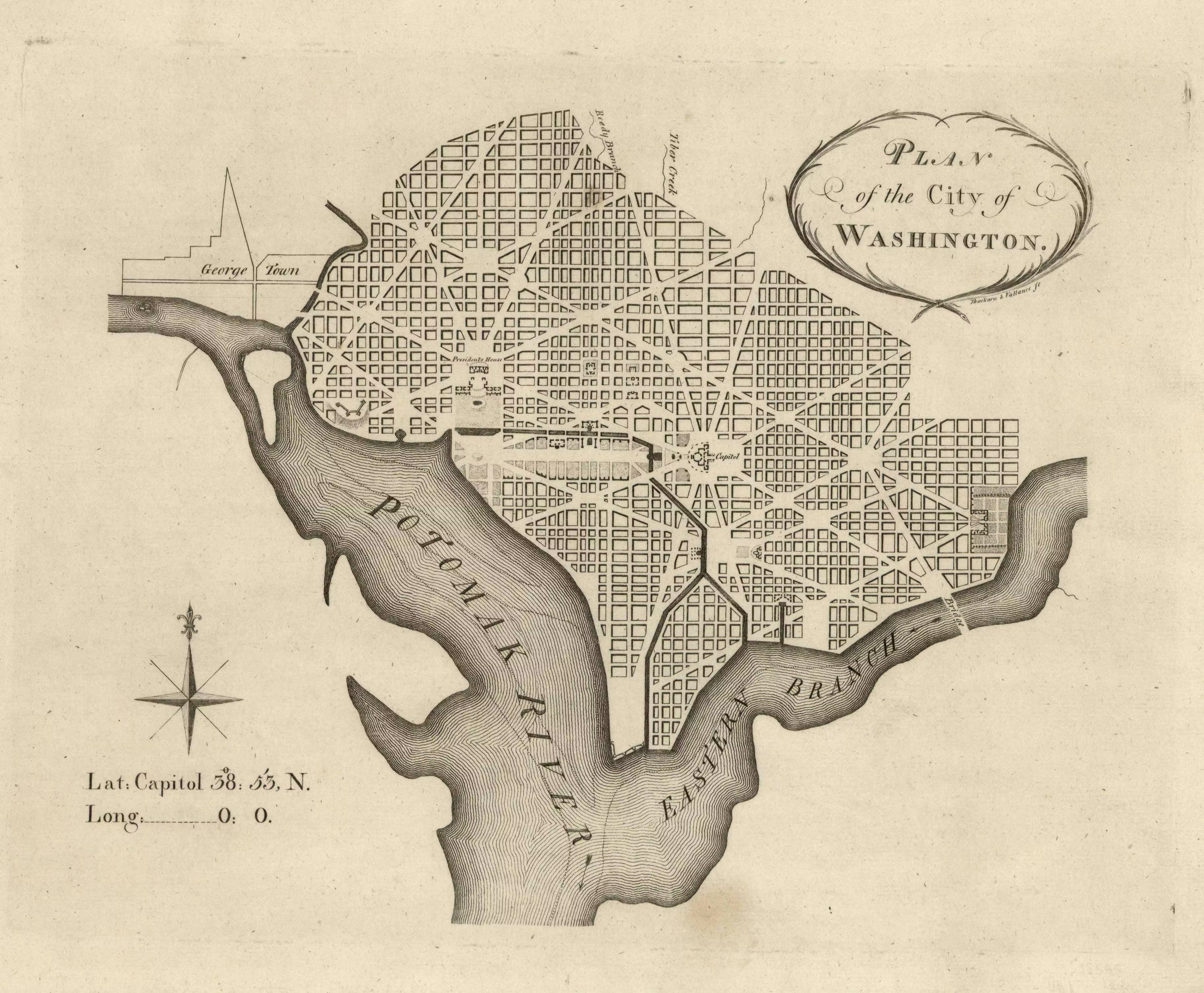
L’Enfant’s plan for Washington.
Neptune in a fountain near the Capitol.

There is also the quirk of the city’s mandatory low skyline that has driven new development to happen in a more traditional urban pattern, with side-by-side building facades forming continuous street walls. In its details, the city is quite a bit more American — the chain stores, the people — but its massing has a certain quality that is reminiscent of Madrid or, or a district like Prati, in Rome.

Buildings on Connecticut Avenue NW.

There is a lot of housing being built. Right now, this is especially true in the blocks north, west, and east of Union Station. An entirely new urban fabric is being assembled, one lot at a time, that is quite impressive. If only New York City could remember how to build like this, we might not have such a housing crisis. (A century ago, it did, in Harlem and the Bronx.)

New housing in NoMa, northwest of Union Station.

It seems that the area — which straddles NoMa and the Near Northeast — was largely composed of small row houses until the past decade; and many of these old homes, as well as vacant lots, are now being replaced with large apartment houses in a pattern that mirrors a traditional urban process. (That said, the transformation is being managed by heavy regulation — contrary to traditional urbanism).

New apartments along the Northeast Corridor in the Near Northeast. Older row houses survive on the central block, amid the growth.

As a cumulative effect of these changes, the area called NoMa is beginning to show massing patterns that resemble the older urban core, to the west (i.e., Metro Center, Downtown, Adams Morgan) — defined by 8-12 story buildings, attached into continuous street walls, and sustaining strips of ground-floor retail that opens onto the sidewalk. The architecture is, of course, nontraditional. East of the tracks, the Near Northeast has a bit further to go before the new development congeals.

New buildings in NoMa.

It is an interesting city to explore. Will share a few more images:

An old pub in Dupont Circle, with newer buildings (subject to the height limit) beyond.
NPR offices, North Capitol Street.
Standing guard at Union Station.
Street signage and a lamppost, with new housing beyond

LegalTowns is a reader-supported publication. To receive new posts and support my work, consider becoming a free or paid subscriber via Substack.

Olmsted’s Brooklyn Comes to Life

In spring, especially, the boundary between Prospect Park and the gloomy, earth-colored blocks of Park Slope is fluid. It is one of the most perfect intersections of 19th-century Romantic landscape architecture and late Victorian common-law urbanism. Viewed on a map, a monotony of gridded blocks makes the boundary between urbs and gardens look like a hard line, defined by the long razor of Prospect Park West. But a few images from a recent visit prove that it is, in fact, a more subtle transition.

Situated within the park, near Prospect Park West, the Litchfield Mansion (1855) predates both the park and the subdivision of urban building lots for Park Slope. A placard teaches that it was once the private home of a Brooklyn industrial magnate. Today it serves as administrative offices for the Parks Department.

The trees of Prospect Park were in full bloom when I visited. The Long Meadow, beyond the mansion, was busy with people, some playing games, others having picnics, a few reading beneath trees.

At the edge of the park, one can see that its influence does not merely end at its surveyed boundary. Instead, the density of trees and plant life, and the colors of nature, extend across Prospect Park West and echo through the cool, shady blocks of the old Victorian neighborhood.

Here is the park block of First Street, afternoon light filtering through the leaves:

And some wavering cornices on the same block:

In early spring, the old trees had already formed canopies more reminiscent of Oglethorpe’s Savannah or of New Orleans’ Garden District than of New York City:

Here are some facades on Third Street, between Eighth and Seventh Avenues:

Massive, hundred-year-old sycamores make parts of the Central Slope feel like a quiet, settled place in the woods — rather than a major city. The cool, enchanting gloom is hard to capture inside the four corners of a picture.

In some blocks, these ancient trees not only line the curbstones — but a second row also occupies a position closer to the building line:

Park Slope is a richly tactile place, with block curbstones, wrought iron gates, gnarly tree trunks, and (in some places) traditional slate sidewalks.

The topography — including the namesake slope — can be seen in the terraced rooflines of the area’s east-west blocks.

In parts of the Central Slope, the street trees are truly massive:

Back in the park at twilight, the buildings of Prospect Park West form a street wall that helps to define the green space.

Four-story buildings front the park on Prospect Park West.

Unfortunately (or fortunately, depending on one’s perspective), zoning and historic preservation have, at the southern end of the park, frozen a relatively low density of development in place.

The continuous street walls that were built early, further north, become shorter as one approaches Bartel Pritchard Square, and as one moves southward along Prospect Park Southwest they begin to show gaps. The lower-rise buildings in these blocks may have merit, but they are not the unbroken cascades of perfect brownstones that served as the basis for the historic district, nor are they the highest and best use of prime park-front building lots. The persistence of gaps in the street wall here, and the sense it projects of incomplete urbanization, illustrates how a traditional urban process was interrupted by 20th-century regulation.

Prospect Park Southwest has not developed a continuous street wall. Image: Google.

Be that as it may, the transition between the western edge of Prospect Park and the Victorian urban fabric of Park Slope — especially in the North and Central Slope — is one of New York’s treasures of the built environment. It bears noting that this gem of urbanism is an artifact of the mix of private, common-law urban growth processes and municipal planning initiatives that drove the growth of American cities in the 19th century — a development context that has now, mostly, regrettably, been forgotten.

LegalTowns is a reader-supported publication. To receive new posts and support my work, consider becoming a free or paid subscriber via Substack.

Ibn Battuta and the Echoes of Another World

I’ve been reading an English translation of the Rihla, an account of Ibn Battuta’s 14th-century journeys through nearly all the known world. So far, it’s fascinating. Starting from his native city of Tangier, in Morocco, the young lawyer began traveling east on Hajj in 1326: first across the Maghrib, then meandering through Egypt and the Levant, and finally turning south into the Hejaz.

Along the way, Battuta offers a sort of Grand Tour of the Medieval Islamic world: bustling urban Tunis (at roughly the time of Ibn Al-Rami, whose treatise on urbanism Besim Hakim introduced to Western readers); the last days of the crumbling ancient Pharos (that Wonderous lighthouse) at Alexandria; the maritime Nile waterfront of Cairo; the Dome of the Rock and other notable sites at Jerusalem; the cosmopolitan markets and charitable largesse of Damascus; and the long Incense Route through the ancient oases towns of the Hejaz — including Hegra and Al Ula.

Mada’in Sâlih (Hegra), Medina, Kingdom of Saudi Arabia (2022).
The oasis at Al Ula, Medina, Kingdom of Saudi Arabia (2022).

Battuta wound up, as a matter of course, at the Mosque of the Prophet at Medina; and next, at his destination, he provided a fascinating account of the city of Mecca, itself, and its people, and their ways. But unlike most pilgrims, in his time or today, Battuta did not promptly return home after completing his religious obligation. Instead, he kept traveling, first with a caravan across the desert, following an eastern Hajj route, the Darb Zubayda, developed and supplied with way stations and water infrastructure by an earlier Abbasid princess; then southeast through the reedy wetlands occupied by the fierce ancestors of today’s Marsh Arabs; northeast through genteel Basra; down the Shatt-al-Arab, where the waters of the Tigris and Euphrates finally come together and exchange the outflows of the Fertile Crescent with the salty tidewaters of the Gulf; around the cities of western Iran; and finally back west to a wrecked Baghdad, in the aftermath of a siege by the Mongols — where I have recently left him on the banks of the Tigris, contemplating the destruction by the Khans.

Ibn Battuta, depicted by Léon Benett (1878).

The Table of Contents tells me that Battuta’s travels will yet take him back to the Hejaz; to Yemen; to “Rum” — that Greek-speaking remnant of the Roman Empire we’d call Byzantium, centered on Constantinople; to India and China; and later to Al-Andalus; and to the interior of Africa. And while he lived in some places for quite some time (on a second visit, he spent three years at Mecca), Battuta traveled for the better part of three decades. Anything to avoid going home to practice law, I suppose.

The Rihla also illustrates the different priorities around which a dominant society can be organized. Early in his travels, at least, Battuta found convents and religious orders in nearly every town and city, supporting countless scholars, and providing hospitality to traveling strangers. Most of these stopping-off points were supported by charitable trusts, having been established by merchants and aristocrats. Contrast this dense constellation of oases from the marketplace in the 1300s Islamic world with the hyper-Florentine values of the postmodern West, where deeply human, non-material pursuits like scholarship, travel, and spirituality must typically be self-financed. Definitions of the sacred and the profane do vary.

A Stormy Night

A few more photos from last month’s quick visit to New Orleans.

A wild storm moved in on the last night of my stay. It had been threatening all afternoon, and the winds began for real about the time I was checking out the Old Absinthe House in the Vieux Carre, some time close to 4 pm. This batch of photos starts out with images of some of the old streetcars on Canal Street, the cardo of modern New Orleans; then moves on to some scenes in the historic bar, once immortalized by Aleister Crowley; then continues into the vanishing city streets as the night rain began to fall.

The rain, at first, came gingerly but ominously. Later, in the overnight hours, it escalated to a crescendo of windblown sheets and lightning. At some point after the Absinthe House, I walked to the Algiers Ferry — only to learn (having reached the far side of the Mississippi) that the rest of the night’s service had been canceled, due to the gathering storm. Ah, the joys of exploration. And so I spent a solid 30 minutes waiting for a Lyft in an absolutely desolate Algiers Point, staring out at the inky river and hoping that what souned like distant gunfire was, in fact, something else. Fortunately, the heavy rains held off until I was safely back at the hotel. In fact, I even had time to duck back into the Carousel Bar for a last icy drink.

Stormy Night

For reference, yes, this was the same incredible storm that people in the Northeast may remember — it moved through New York about a day later.

The Living Music of New Orleans

I was impressed by the vitality of live music in this city. In the evenings, nearly every bar had music. Not surprisingly, jazz and blues predominated, but other genres could be heard as well. And practically everyone I heard was good. Here are some photos, mostly from Faubourg Marigny, but also from outside the French Market and inside the Hotel Monteleone in the Vieux Carré. I probably spent the longest time at Bamboula’s. That’s not saying much — three complete sets (and a couple of Sazeracs, the high price of entry).

Here’s a sample of the Midnight Ramblers at Bamboula’s — skip to about 1:11 for the classic “Bill Bailey, Won’t You Please Come Home?

Blue Nile and Apple Barrel had some enchanting sounds spilling out onto the sidewalk, as well — which led me into each venue briefly.

Midnight Ramblers at Bamboula’s.

A later set, great music, didn’t catch their name.

Here’s an extended sample from the Hotel Monteleone’s Carousel Bar (with a bit of the carousel, below):

A Haunted and Enchanted City

I spent part of last week in New Orleans — my first time in that city. The photos included in this post are mostly of architecture and a few street scenes around the Vieux Carré. I’ll post other batches, including of jazz clubs, houses in the Garden District, and the enchanting light that came over the streets during an impending and fierce storm (including a visit to the again-going Old Absinthe House) in a later post.

A group of young women, dressed as angels (with iridescent haloes), congregate in front of the St. Louis Cathedral to prepare for a Joan of Arc-Twelfth Night parade that also marks the start of the Mardi Gras season. Photo: Theo Mackey Pollack.

I hope to spend time in New Orleans, again. It is a fascinating city to explore, and to try to process, on so many levels: its architecture and urbanism, its layered social and cultural history, the surprising way in which its high culture, cheap alcohol, traditional Catholicism, hedonism, classicism, neon, jazz, old money, abject poverty, and all else seem to (mostly) gracefully coexist. It reminds me of no other place in America, yet it could not exist in any other country.

The streets of New Orleans (at least, those in the Vieux Carré) are reminiscent of a Mediterranean city, maybe one in Spain, with low rooflines and floral balconies and breezy palms, and everything organized on a grid around a central plaza (anchored, of course, by a fine old church). Other aspects seem not-quite-American: many people dress more carefully in New Orleans than most Americans do elsewhere (except, perhaps, Boston). Streetcars still operate. Alcohol is everywhere in public. As is live music. And, in stark contrast to the genericism that has now conquered much of the United States, the local culture here struck me as the most vital I’d encountered in the States. That is, people participate in it. (Following the image above, an entire parade, including floats and more costumery, sponsored by a local krewe, would arrive.) Yet, for all its distinctions, it is a distinctly American city, combining influences that have only ever converged in this corner of the Deep South.

There were moments when I felt like I had opened a time capsule and entered a world where the twentieth century hadn’t quite arrived. Instead, this potent preserve of Victoriana and Vaudeville was floating obliviously on the sea of 21st century America. I’m sure such an impression is engineered by the tourism bureau; and pressing beyond the confines of historic neighborhoods would yield plenty of evidence to the contrary. But with such a concentration of historic spaces, inside and out, and so many people still participating in centuries-old traditions, any line between fantasy and living memory, like other contrasts in this strangely familiar city, can seem ephemeral.

Hover over or tap the image below for slideshow.

Vieux Carré

London: Work + Exploring

Our group made a quick trip to London last summer (2022) to meet with a collaborating team that’s based there. I stayed a few extra nights because I wanted to explore the city a little bit. Fortuitously, my visit coincided with an infamous heat wave in which temperatures hovered around 100° F: not the most pleasant walking-around weather. But I determined to make the best of my brief visit, and to take some photos that captured the city’s beauty, history, and spirit — and of course its urban form.

I stayed near Victoria Station. Many of these photos are from three walks originating from the hotel and reaching into Lambeth, Westminster, St. James Park, Hyde Park, and Belgravia. The fourth and longest (after the heatwave had broken) began in Whitechapel. Heading into the City, I went down to the embankment near the Tower and followed the Thames up to around the Monument and St. Mary Woolnoth. From there, I roughly followed the Roman Wall to the Barbican, then headed back down toward St. Paul’s. (By then, I was exhausted enough to hail a taxi back to the hotel).

A few small takeaways about London’s urban personality:

  • The Thames is London’s Grand Canal: functional, focal, and eternal. The urban fabric builds out from its banks.
  • The meandering streets, like so much that is English, evoke the benevolent chaos of plants: their roots and branches are of a piece with England’s common law, language, and gardens. For all its modernity, England is a deeply agrarian place.
  • In July, there are lilacs everywhere: little shocks of purple against stone walls. The whole city has a floral and smoky scent, a mix of lilacs, gardens, European perfume — and city smoke.

Edward Hopper’s New York

Enough writing. Time for some visuals. Let’s start with some photos from the Edward Hopper show that I saw at the Whitney Museum early this year. Some of the shots are at an angle; I think I had in mind that since these were familiar paintings, it might be interesting to see them from a slightly different perspective. Not sure how well that worked out. You can judge. Before going, I had posted a link to a review in The New Criterion. So it feels like I’m closing a loop with this entry.

Breaking Records: American Homelessness

The United States passed an ignominious milestone this year, with more than 650,000 homeless people. This figure — a record, according to Axios, and almost certainly a lowball — is inextricably linked to the nation’s chronic, insufficient production of new housing units. Of course, in this musical-chairs game of a housing market, the most vulnerable groups have been hit hardest. Per Axios, some of the numbers are staggering:

  • Homeless families with children increased by 16% in 2023, comprising 28% of the US homeless population — roughly 186,000 people.
  • Despite being just 13 percent of the US population, African-Americans made up 37% of the US homeless population, and 50% (!) of homeless people in families with children — roughly 90,000 people.
  • 61 percent of homeless adults were men, including 90 percent of homeless veterans.

Meanwhile, the Wall Street Journal reported separately in September that homelessness among seniors is reaching levels not seen since the Great Depression.

This is a slow-motion disaster. It is also an epic failure of the nation’s moral priorities, as enshrined in law. While it is true, of course, that addiction, mental illness, and poverty all contribute to people becoming homeless, I think it is important that the role of high housing costs, made worse by limits on missing-middle housing and SROs, not be ignored. There was a time when American cities (and towns, and suburbs) could grow creatively and quickly to house a rising population. Then, it became the law’s priority, in too many places, to oppose any change. Homelessness is a visible human consequence.